
The Season of Lent 2026
Wednesday, February 18 to Saturday, April 4, 2026
“If anyone would come after me, let him deny himself and take up his cross and follow me.”
Special Services and Programs:
Ash Wednesday – Feb. 18th at 12:00 PM and 6:00 PM
Ash Wednesday marks the first step in preparing our hearts to commemorate Christ’s death and to celebrate his resurrection. It points to why we need what Christ offers. Join us for the Imposition of Ashes and Holy Eucharist.
Stations of the Cross – Feb. 20th
- 6:30 PM – Stations of the Cross with Sound Healer Bradford Tildon.
Maundy Thursday – April 2nd
- 6:30 PM – Simple supper with eucharist in the Parish Hall, followed by Washing of the Feet and Stripping of the Altar in the sanctuary.
Good Friday – April 3rd
- 12:00 PM – Traditional prayer service with reading of St. John’s Passion
Easter Vigil – April 4th
- 6:30 PM – We’re invited to participate in an Easter Vigil at St. Thomas’s New Haven, Bryan Dougan will be preaching.
Easter Sunday – April 5th
- 8:00 AM – Holy Eucharist Rite I
- 10:00 AM – Holy Eucharist Rite II (Festive family service with choir and the Easter Bunny!)

Book Study
Being Christian, by Rowan Williams
Month of March
For Lent, we invite you to take a deeper dive into the foundation of our Christian faith. Join us in reading Being Christian: Baptism, Bible, Eucharist, Prayer by Rowan Williams (the former Archbishop of Canterbury).
For our first session (chapter 1) we will meet at St. Thomas’s New Haven (890 Whitney Ave, New Haven) on Wednesday, March 4 at 6:30pm for a potluck supper. The following three meetings (a chapter a week) will take place on Zoom with a choice of Wednesday or Thursday evenings for the remainder of March.
Please come to the first meeting having read chapter 1. We hope you can join us!
A Forty Day Journey
 Lent is a season of the Church Year that calls Christians to focus on repentance and personal devotion in light of the coming celebration of Easter.
The forty-day period of Lent connects with many Scriptural events important in the history of salvation: the forty days of the flood, the forty years of Israel’s wilderness wanderings, Moses’ forty days on Mount Sinai when he received the Law, and Jesus’ forty days of temptation in the desert.
The season of Lent is somber. In the Church’s worship, a penitential tone is expressed in various ways, both liturgically and visually:
- Vestments are changed to purple, a color associated with mourning.
- The shout of praise “Alleluia” is eliminated from all acts of worship.
- The Eucharist begins with an acclamation that acknowledges our need for mercy. The Celebrant says, “Bless the Lord who forgives all our sins,” and the people respond, “His mercy endures forever.”
- The Gloria (“Glory be to God on high”) is replaced by the Kyrie Eleison (“Lord have mercy”) and the service music changes to more penitential settings.
- The priest’s final blessing over the congregation is replaced with a solemn prayer focusing on the Lenten journey.
An Invitation to a Holy Lent
The first day of Lent is Ash Wednesday. On this day Episcopalians, along with many other Christians in different traditions, wear a smudgy cross of ash on their foreheads to remind them of their mortality. This ancient ritual links us to countless generations who have turned humbly to God for help in absorbing the knowledge of our inevitable death in a way that will shape our living.
In this service, the priest addresses the people, saying:
I invite you, therefore, in the name of the Church, to the observance of a holy Lent, by self-examination and repentance; by prayer, fasting, and self-denial; and by reading and meditating on God’s holy Word. (BCP, 265)
We see in this invitation that there are six specific ways in which Christians are called to deepen their devotion in this season:
- By self-examination. This means setting aside time to intentionally reflect upon one’s thoughts and actions, acknowledging the ways in which we fall short of God’s goodness and love.
- By repentance. To repent means to have “a change of heart” and to “turn around” from actions and attitudes contrary to God’s will. This means honestly confessing our sins to God and receiving his forgiveness.
- By prayer. This calls us to take part in the Church’s corporate acts of worship as well as the setting aside of time for personal prayer.
- By fasting. To fast is to abstain from certain foods or all food for a period of time.
- By self-denial. Denying oneself in Lent means giving up certain luxuries, even legitimate pleasures, in order to focus oneself spiritually.
- By reading and meditating on God’s holy Word. In Lent, believers are especially called to read and reflect on Scripture in a daily way.
Lent puts into practice the words of Jesus: “If anyone would come after me, let him deny himself and take up his cross and follow me.” (St. Matthew 16:24) Lent is a time for cultivating spiritual disciplines — whether giving something up or taking something on — that foster spiritual growth.
This growth happens through group activities at church as well as personal commitments at home.
Resources for Lent
Self-examination, repentance and prayer
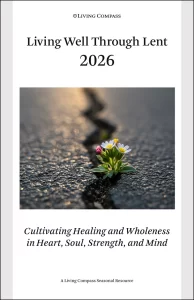 Living Well Through Lent 2026
These booklets offer daily readings for personal and individual self-reflection during Lent. At the end of the book, you will find scripture quotes, prayers and practices for Lent.
You can go online to order this booklet. You can also sign up to receive each of the day’s readings via a daily email from Ash Wednesday through Easter. You’ll receive daily emails, one for each day of Lent, plus Easter. If at any point you no longer want to receive the emails, you can unsubscribe at any time.
A Lenten Practice: Modify Your Diet
What we buy, what we eat, what we waste – all make a difference.
Fasting or abstaining from certain activities in our lives can help us become aware of the things that tempt us to engage in behavior that is harmful to ourselves, other people, or the world in which we live. Some popular practices for fasting include giving up or cutting back on:
- Social Media
- Sugar
- Alcohol
- Online shopping
- Clutter
- Complaining
- TV
- Video games
- Soda
Our Eco-justice committee encourages us to think about the consequences of our eating habits. Here you will find information, recipes and more to that can help make a difference in our lives and in the world.